The gradient method with constant Nesterov momentum: Smooth and convex
Problem setup
Consider the unconstrained minimization problem
where \(f : \calH \to \reals\) is convex and \(L\)-smooth with \(L>0\).
For initial points \(x^{-1}, x^0 \in \calH\), momentum \(\delta \in \reals\), and step size \(\gamma \in \reals_{++}\), the gradient method with constant Nesterov-momentum is
In this example, we search for a feasible Lyapunov certificate with \(\rho=1\) and condition (C4) enabled such that
where \(x^\star \in \Argmin_{x \in \calH} f(x)\).
Model the problem in AutoLyap and certify sublinear convergence
\(f\) is modeled by
SmoothConvex.The optimization problem is represented by
InclusionProblem.The update rule is represented by
GradientNesterovMomentum.Sublinear function-value parameters are obtained with
IterationIndependent.SublinearConvergence.get_parameters_function_value_suboptimality.Feasibility at fixed \(\rho=1\) is checked with
IterationIndependent.search_lyapunovandremove_C4=False.
Run the iteration-independent analysis
This example uses the MOSEK Fusion backend (backend="mosek_fusion").
Install the optional MOSEK dependency first:
pip install "autolyap[mosek]"
from autolyap import IterationIndependent, SolverOptions
from autolyap.algorithms import GradientNesterovMomentum
from autolyap.problemclass import InclusionProblem, SmoothConvex

L = 1.0
gamma = 1.0
delta = 0.5

problem = InclusionProblem([SmoothConvex(L)])
algorithm = GradientNesterovMomentum(gamma=gamma, delta=delta)

MOSEK_PARAMS = {
    "intpntCoTolPfeas": 1e-6,
    "intpntCoTolDfeas": 1e-6,
    "intpntCoTolRelGap": 1e-6,
    "intpntMaxIterations": 10000,
}
solver_options = SolverOptions(
    backend="mosek_fusion",
    mosek_params=MOSEK_PARAMS,
)
# License-free option:
# solver_options = SolverOptions(backend="cvxpy", cvxpy_solver="CLARABEL")

# Build V(P, p, k) and R(T, t, k) for function-value suboptimality.
P, p, T, t = IterationIndependent.SublinearConvergence.get_parameters_function_value_suboptimality(
    algorithm,
    tau=0,
)

result = IterationIndependent.search_lyapunov(
    problem,
    algorithm,
    P,
    T,
    p=p,
    t=t,
    rho=1.0,
    remove_C4=False,
    solver_options=solver_options,
)

if result["status"] != "feasible":
    raise RuntimeError("No feasible Lyapunov certificate for this (gamma, delta) pair.")

print("Feasible certificate found with C4 enabled.")
What to inspect in result:
result["status"]:feasible,infeasible, ornot_solved.result["solve_status"]: raw backend status.result["rho"]: the fixed contraction parameter (1.0in this sublinear setup).result["certificate"]: Lyapunov certificate matrices/scalars.
When the certificate is feasible, the certified function-value convergence is
where \(x^\star \in \Argmin_{x \in \calH} f(x)\).
Equivalently,
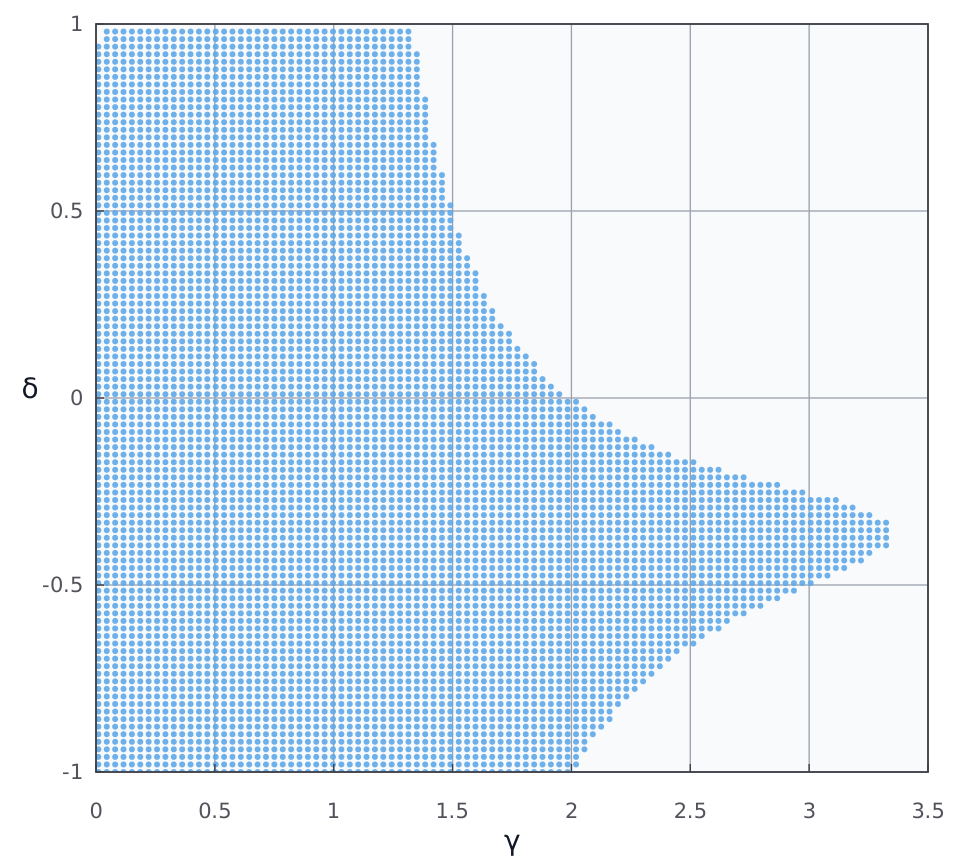
Sweeping over multiple values of \(\gamma \in (0,4)\) and \(\delta \in (-1,1)\) with \(L=1\) gives the plot below, where each blue dot denotes a parameter pair with a feasible certificate.