The information-theoretic exact method
Problem setup
Consider the unconstrained minimization problem
where \(f : \calH \to \reals\) is \(\mu\)-strongly convex and \(L\)-smooth with \(0 < \mu < L\).
For initial points \(x^0, z^0 \in \calH\), set \(q=\mu/L\), \(y^{-1}=x^0=z^0\), and \(\tilde{A}_0=0\). For each \(k \in \naturals\), define
The information-theoretic exact method (ITEM) [TD23] is
In this example, we search for the smallest AutoLyap certificate constant \(c_K\) such that
where \(x^\star \in \Argmin_{x \in \calH} f(x)\).
Model the problem in AutoLyap and search for the smallest c_K
\(f\) is modeled by
SmoothStronglyConvex.The optimization problem is represented by
InclusionProblem.The update rule is represented by
ITEM.Initial and final distance-to-solution parameters \(\|z^k-x^\star\|^2\) are obtained with
IterationDependent.get_parameters_state_component_distance_to_solutionusingell=2(ITEM state is \((x^k,z^k)\)).The certificate constant is computed with
IterationDependent.search_lyapunov.
Run the iteration-dependent analysis
This example uses the MOSEK Fusion backend (backend="mosek_fusion").
Install the optional MOSEK dependency first:
pip install "autolyap[mosek]"
from autolyap import IterationDependent, SolverOptions
from autolyap.algorithms import ITEM
from autolyap.problemclass import InclusionProblem, SmoothStronglyConvex

mu = 1.0
L = 200.0
K = 10
q = mu / L

problem = InclusionProblem([SmoothStronglyConvex(mu=mu, L=L)])
algorithm = ITEM(mu=mu, L=L)
solver_options = SolverOptions(backend="mosek_fusion")
# License-free option:
# solver_options = SolverOptions(backend="cvxpy", cvxpy_solver="CLARABEL")

Q_0, q_0 = IterationDependent.get_parameters_state_component_distance_to_solution(
    algorithm,
    k=0,
    ell=2,
)
Q_K, q_K = IterationDependent.get_parameters_state_component_distance_to_solution(
    algorithm,
    k=K,
    ell=2,
)

result = IterationDependent.search_lyapunov(
    problem,
    algorithm,
    K,
    Q_0,
    Q_K,
    q_0=q_0,
    q_K=q_K,
    solver_options=solver_options,
)
if result["status"] != "feasible":
    raise RuntimeError("No feasible chained Lyapunov certificate for ITEM.")

c_K_autolyap = result["c_K"]
A_tilde_K = algorithm.get_A(K)
c_K_theory = 1.0 / (1.0 + q * A_tilde_K)

print(f"ITEM c_K (AutoLyap): {c_K_autolyap:.6e}")
print(f"ITEM c_K (theory):   {c_K_theory:.6e}")
The computed value ITEM c_K (AutoLyap) matches (up to solver numerical
tolerances) the theoretical horizon-K expression from
[TD23, Theorem 3]:
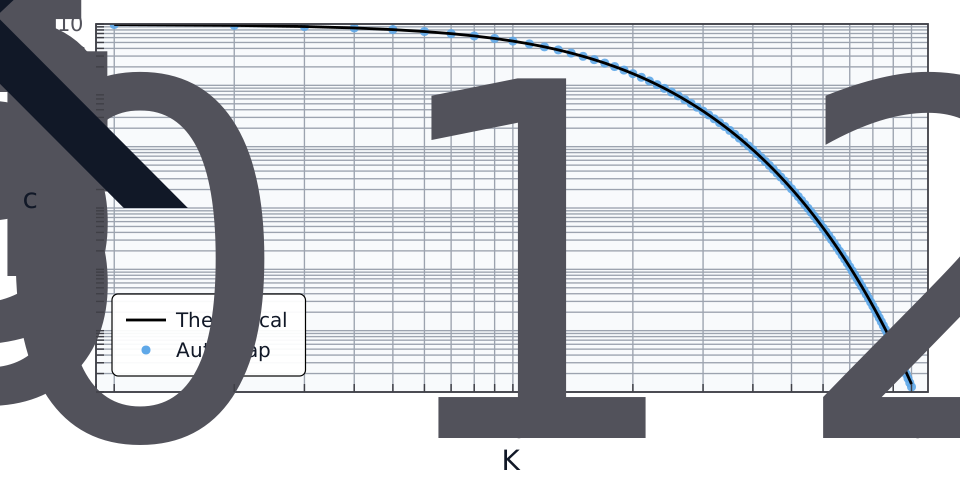
Sweeping over \(K \in \llbracket 1, 100\rrbracket\) gives the log-log plot below, with the theoretical bound in black and AutoLyap certificates as blue dots.
References
Adrien Taylor and Yoel Drori. An optimal gradient method for smooth strongly convex minimization. Mathematical Programming, 199(1-2):557–594, 2023. doi:10.1007/s10107-022-01839-y.