The gradient method: Smooth and strongly convex
Problem setup
Consider the unconstrained minimization problem
where \(f : \calH \to \reals\) is \(\mu\)-strongly convex and \(L\)-smooth, with \(0 < \mu < L\).
For an initial point \(x^0 \in \calH\) and step size \(0 < \gamma < 2/L\), the gradient update is
In this example, we search for the smallest contraction factor \(\rho\in[0,1)\) provable using AutoLyap such that
where
Model the problem in AutoLyap and search for the smallest rho
\(f\) is modeled by
SmoothStronglyConvex.The optimization problem is represented by
InclusionProblem.The update rule is represented by
GradientMethod.Distance-to-solution parameters are obtained with
IterationIndependent.LinearConvergence.get_parameters_distance_to_solution.The contraction factor is searched with
IterationIndependent.LinearConvergence.bisection_search_rho.
Run the iteration-independent analysis
This example uses the MOSEK Fusion backend (backend="mosek_fusion").
Install the optional MOSEK dependency first:
pip install "autolyap[mosek]"
from autolyap import IterationIndependent, SolverOptions
from autolyap.algorithms import GradientMethod
from autolyap.problemclass import InclusionProblem, SmoothStronglyConvex

mu = 1.0
L = 4.0
gamma = 0.2

problem = InclusionProblem([SmoothStronglyConvex(mu, L)])
algorithm = GradientMethod(gamma=gamma)
solver_options = SolverOptions(backend="mosek_fusion")
# License-free option:
# solver_options = SolverOptions(backend="cvxpy", cvxpy_solver="CLARABEL")

P, p, T, t = IterationIndependent.LinearConvergence.get_parameters_distance_to_solution(
    algorithm
)

result = IterationIndependent.LinearConvergence.bisection_search_rho(
    problem,
    algorithm,
    P,
    T,
    p=p,
    t=t,
    S_equals_T=True,
    s_equals_t=True,
    remove_C3=True,
    solver_options=solver_options,
)

if result["status"] != "feasible":
    raise RuntimeError("No feasible Lyapunov certificate in the requested rho interval.")

rho_autolyap = result["rho"]
rho_theory = max(gamma * L - 1.0, 1.0 - gamma * mu) ** 2

print(f"rho (AutoLyap): {rho_autolyap:.8f}")
print(f"rho (theory):   {rho_theory:.8f}")
What to inspect in result:
result["status"]:feasible,infeasible, ornot_solved.result["solve_status"]: raw backend status.result["rho"]: certified contraction factor when feasible.result["certificate"]: Lyapunov certificate matrices/scalars.
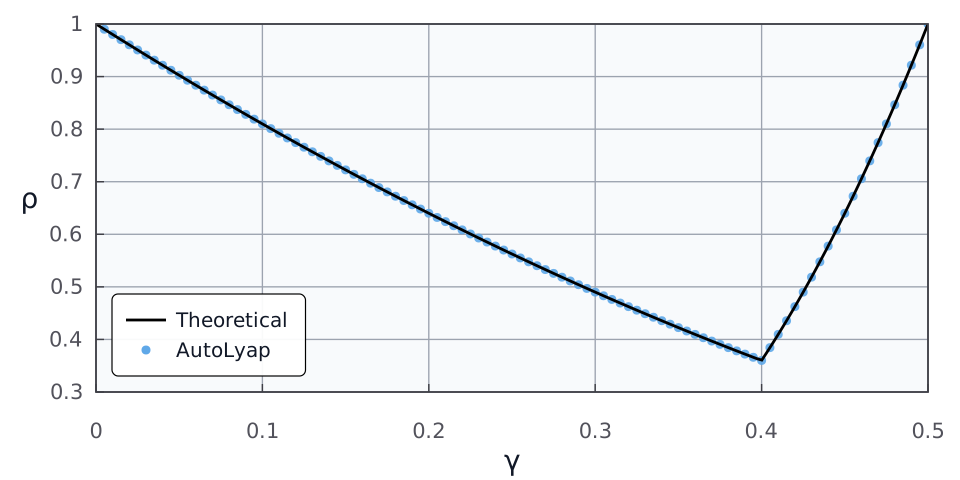
The computed value rho (AutoLyap) matches (up to solver numerical
tolerances) the theoretical rate expression for gradient methods
[Pol63]:
Equivalently,
Sweeping over 100 values of \(\gamma\) on \(0 < \gamma \le 2/L\) gives the plot below, with the theoretical rate in black and AutoLyap certificates as blue dots.
References
B. T. Polyak. Gradient methods for the minimisation of functionals. USSR Computational Mathematics and Mathematical Physics, 3(4):864–878, 1963. doi:10.1016/0041-5553(63)90382-3.