The Douglas–Rachford method: Cocoercive + strongly monotone
Problem setup
Consider the monotone inclusion
where:
\(G_1 : \calH \to \calH\) is \(\beta\)-cocoercive, with \(\beta>0\),
\(G_2 : \calH \rightrightarrows \calH\) is \(\mu\)-strongly monotone and maximally monotone, with \(\mu>0\).
For an initial point \(x^0 \in \calH\), step size \(\gamma \in \reals_{++}\), and relaxation \(\lambda \in \reals\), the Douglas–Rachford update is
In this example, we search for the smallest contraction factor \(\rho\in[0,1)\) provable using AutoLyap such that
where
Model the problem in AutoLyap and search for the smallest rho
\(G_1\) is modeled by
Cocoercive.\(G_2\) is modeled by
StronglyMonotone.The full inclusion is built with
InclusionProblem.The update rule is represented by
DouglasRachford.Distance-to-solution parameters are obtained with
IterationIndependent.LinearConvergence.get_parameters_distance_to_solution.The contraction factor is searched with
IterationIndependent.LinearConvergence.bisection_search_rho.
Run the iteration-independent analysis
This example uses the MOSEK Fusion backend (backend="mosek_fusion").
Install the optional MOSEK dependency first:
pip install "autolyap[mosek]"
import numpy as np

from autolyap import SolverOptions
from autolyap.algorithms import DouglasRachford
from autolyap.problemclass import (
    Cocoercive,
    InclusionProblem,
    StronglyMonotone,
)
from autolyap.iteration_independent import IterationIndependent

mu = 1.0
beta = 1.0
gamma = 1.0
lambda_value = 1.2

problem = InclusionProblem(
    [
        Cocoercive(beta=beta),  # G1
        StronglyMonotone(mu=mu),  # G2
    ]
)
algorithm = DouglasRachford(gamma=gamma, lambda_value=lambda_value, type="operator")
solver_options = SolverOptions(backend="mosek_fusion")
# License-free option:
# solver_options = SolverOptions(backend="cvxpy", cvxpy_solver="CLARABEL")

# Build V(P, p, k) and R(T, t, k) for distance-to-solution analysis.
P, T = IterationIndependent.LinearConvergence.get_parameters_distance_to_solution(
    algorithm
)

result = IterationIndependent.LinearConvergence.bisection_search_rho(
    problem,
    algorithm,
    P,
    T,
    S_equals_T=True,
    s_equals_t=True,
    remove_C3=True,
    solver_options=solver_options,
)

if result["status"] != "feasible":
    raise RuntimeError("No feasible Lyapunov certificate in the requested rho interval.")

rho_autolyap = result["rho"]

def rho_theoretical(mu: float, beta: float, lambda_value: float, gamma: float) -> float:
    scaled_mu = gamma * mu
    scaled_beta = beta / gamma

    if (
        (scaled_mu * scaled_beta - scaled_mu + scaled_beta < 0.0)
        and (
            lambda_value
            <= 2.0
            * ((scaled_beta + 1.0) * (scaled_mu - scaled_beta - scaled_mu * scaled_beta))
            / (
                scaled_mu
                + scaled_mu * scaled_beta
                - scaled_beta
                - scaled_beta ** 2
                - 2.0 * scaled_mu * scaled_beta ** 2
            )
        )
    ):
        return abs(1.0 - lambda_value * (scaled_beta / (scaled_beta + 1.0))) ** 2

    if (
        (scaled_mu * scaled_beta - scaled_mu - scaled_beta > 0.0)
        and (
            lambda_value
            <= 2.0
            * (
                scaled_mu ** 2
                + scaled_beta ** 2
                + scaled_mu * scaled_beta
                + scaled_mu
                + scaled_beta
                - scaled_mu ** 2 * scaled_beta ** 2
            )
            / (
                scaled_mu ** 2
                + scaled_beta ** 2
                + scaled_mu ** 2 * scaled_beta
                + scaled_mu * scaled_beta ** 2
                + scaled_mu
                + scaled_beta
                - 2.0 * scaled_mu ** 2 * scaled_beta ** 2
            )
        )
    ):
        return abs(
            1.0
            - lambda_value
            * (
                (1.0 + scaled_mu * scaled_beta)
                / ((scaled_mu + 1.0) * (scaled_beta + 1.0))
            )
        ) ** 2

    if lambda_value >= 2.0 * (scaled_mu * scaled_beta + scaled_mu + scaled_beta) / (
        2.0 * scaled_mu * scaled_beta + scaled_mu + scaled_beta
    ):
        return abs(1.0 - lambda_value) ** 2

    if (
        (scaled_mu * scaled_beta + scaled_mu - scaled_beta < 0.0)
        and (
            lambda_value
            <= 2.0
            * ((scaled_mu + 1.0) * (scaled_beta - scaled_mu - scaled_mu * scaled_beta))
            / (
                scaled_beta
                + scaled_mu * scaled_beta
                - scaled_mu
                - scaled_mu ** 2
                - 2.0 * scaled_mu ** 2 * scaled_beta
            )
        )
    ):
        return abs(1.0 - lambda_value * (scaled_mu / (scaled_mu + 1.0))) ** 2

    numerator = (
        (
            (2.0 - lambda_value) * scaled_mu * (scaled_beta + 1.0)
            + lambda_value * scaled_beta * (1.0 - scaled_mu)
        )
        * (
            (2.0 - lambda_value) * scaled_beta * (scaled_mu + 1.0)
            + lambda_value * scaled_mu * (1.0 - scaled_beta)
        )
    )
    denominator = scaled_mu * scaled_beta * (
        2.0 * scaled_mu * scaled_beta * (1.0 - lambda_value)
        + (2.0 - lambda_value) * (scaled_mu + scaled_beta + 1.0)
    )
    return ((np.sqrt(2.0 - lambda_value) / 2.0) * np.sqrt(numerator / denominator)) ** 2


rho_theory = rho_theoretical(mu, beta, lambda_value, gamma)

print(f"rho (AutoLyap): {rho_autolyap:.8f}")
print(f"rho (theory):   {rho_theory:.8f}")
What to inspect in result:
result["status"]:feasible,infeasible, ornot_solved.result["solve_status"]: raw backend status.result["rho"]: certified contraction factor when feasible.result["certificate"]: Lyapunov certificate matrices/scalars.
The computed value rho (AutoLyap) matches (up to solver numerical tolerances)
the theoretical rate expression in
[RTBG20, Theorem 4.1], i.e.,
where
with
and
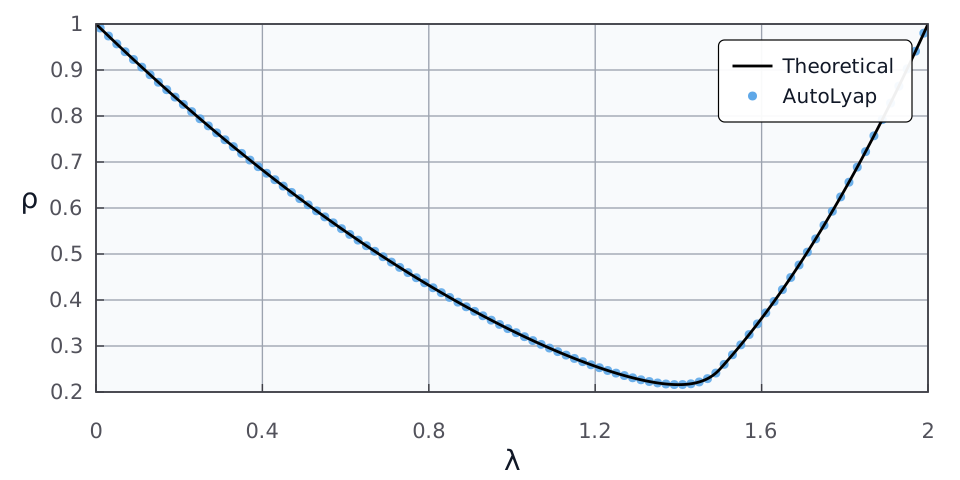
Sweeping over 100 values of \(\lambda\) on \(0 < \lambda < 2\) (with \(\mu=1\), \(\beta=1\), \(\gamma=1\)) gives the plot below, with the theoretical rate from [RTBG20, Theorem 4.1] in black and AutoLyap certificates as blue dots.
References
Ernest K. Ryu, Adrien B. Taylor, Carolina Bergeling, and Pontus Giselsson. Operator splitting performance estimation: Tight contraction factors and optimal parameter selection. SIAM Journal on Optimization, 30(3):2251–2271, January 2020. doi:10.1137/19m1304854.