The Davis–Yin three-operator splitting method
Problem setup
Consider the composite minimization problem
where:
\(f_1 : \calH \to \reals\) is convex and \(L_1\)-smooth, with \(L_1>0\),
\(f_2 : \calH \to \reals\) is \(\mu_2\)-strongly convex and \(L_2\)-smooth, with \(0<\mu_2\le L_2\),
\(f_3 : \calH \to \reals \cup \set{\pm\infty}\) is proper, convex, and lower semicontinuous.
Equivalently, we solve
For an initial point \(x^0 \in \calH\), step size \(\gamma \in \reals_{++}\), and relaxation \(\lambda \in \reals\), the Davis–Yin method [DY17] is
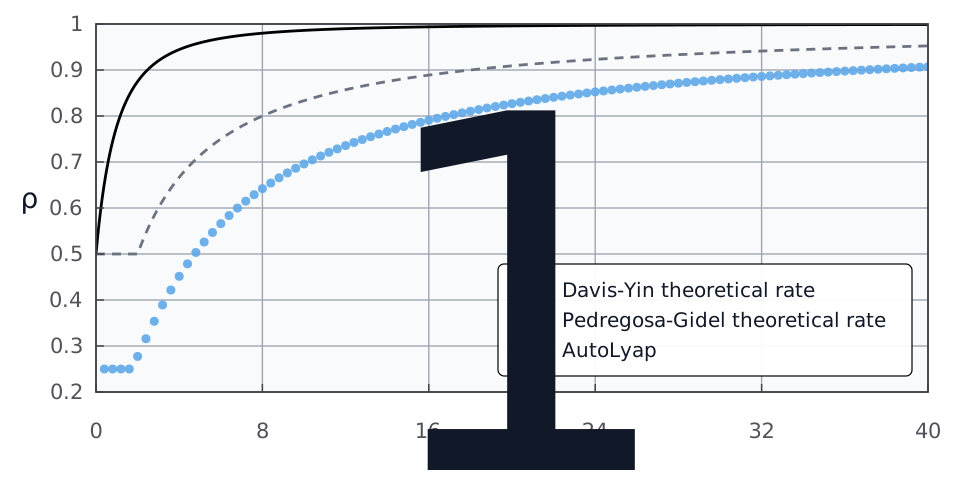
In this example, we fix \(\mu_2 = 1\), \(L_2 = 2\), \(\lambda = 1\), \(\gamma = 1/L_2\), sweep \(L_1 \in (0, 40]\), and search for the smallest contraction factor \(\rho\in[0,1)\) provable using AutoLyap such that
where
Model the problem in AutoLyap and search for the smallest rho
\(f_1\) is modeled by
SmoothConvex.\(f_2\) is modeled by
SmoothStronglyConvex.\(f_3\) is modeled by
Convex.The inclusion is represented by
InclusionProblem.The update rule is represented by
DavisYin.Distance-to-solution parameters are obtained with
IterationIndependent.LinearConvergence.get_parameters_distance_to_solution.The contraction factor is searched with
IterationIndependent.LinearConvergence.bisection_search_rho.
Run the iteration-independent analysis
This example uses the MOSEK Fusion backend (backend="mosek_fusion").
Install the optional MOSEK dependency first:
pip install "autolyap[mosek]"
from autolyap import IterationIndependent, SolverOptions
from autolyap.algorithms import DavisYin
from autolyap.problemclass import Convex, InclusionProblem, SmoothConvex, SmoothStronglyConvex

L1 = 1.0
mu2 = 1.0
L2 = 2.0
lambda_value = 1.0
gamma = 1.0 / L2

problem = InclusionProblem(
    [
        SmoothConvex(L=L1),  # f1
        SmoothStronglyConvex(mu=mu2, L=L2),  # f2
        Convex(),  # f3
    ]
)
algorithm = DavisYin(gamma=gamma, lambda_value=lambda_value)
solver_options = SolverOptions(backend="mosek_fusion")
# License-free option:
# solver_options = SolverOptions(backend="cvxpy", cvxpy_solver="CLARABEL")

P, p, T, t = IterationIndependent.LinearConvergence.get_parameters_distance_to_solution(
    algorithm
)

result = IterationIndependent.LinearConvergence.bisection_search_rho(
    problem,
    algorithm,
    P,
    T,
    p=p,
    t=t,
    S_equals_T=True,
    s_equals_t=True,
    remove_C3=True,
    solver_options=solver_options,
)

if result["status"] != "feasible":
    raise RuntimeError("No feasible Lyapunov certificate in the requested rho interval.")

rho_autolyap = result["rho"]
rho_davis_yin = 1.0 - mu2 / (L2 * (1.0 + L1 / L2) ** 2)
rho_pedregosa_gidel = 1.0 - min(mu2 / L2, 1.0 / (1.0 + L1 / L2))

print(f"rho (AutoLyap):         {rho_autolyap:.8f}")
print(f"rho (Davis-Yin bound):  {rho_davis_yin:.8f}")
print(f"rho (Pedregosa-Gidel):  {rho_pedregosa_gidel:.8f}")
What to inspect in result:
result["status"]:feasible,infeasible, ornot_solved.result["solve_status"]: raw backend status.result["rho"]: certified contraction factor when feasible.result["certificate"]: Lyapunov certificate matrices/scalars.
For \(\lambda=1\) and \(\gamma=1/L_2\), we compare against:
This is the specialization of [DY15, Theorem D.6, case 6] under:
case-6 assumptions (
BLipschitz andCstrongly monotone),parameter choice \(\lambda=1\),
limiting choices \(\varepsilon \to 1\) and \(\eta \to 1/2\),
identifications \(L_B=L_1\), \(\mu_C=\mu_2\), and \(\gamma=1/L_2\).
and
This matches the non-adaptive TOS specialization of [PG18, Eq. (16), Theorem 3]:
define \(\rho=\mu_2\min\{\gamma,\tau/L_2\}\) and \(\sigma=1/(1+\gamma L_1)\),
use \(\tau=1\) and \(\gamma=1/L_2\),
then \(\rho=\mu_2/L_2\) and \(\sigma=1/(1+L_1/L_2)\), which yields \(1-\min\{\rho,\sigma\}\).
Sweeping over 100 values of \(L_1\) on \((0, 40]\) gives the plot below, with the two theoretical expressions as lines and AutoLyap certificates as blue dots.
References
Damek Davis and Wotao Yin. A three-operator splitting scheme and its optimization applications. arXiv preprint arXiv:1504.01032, April 2015. arXiv:1504.01032v1.
Damek Davis and Wotao Yin. A three-operator splitting scheme and its optimization applications. Set-Valued and Variational Analysis, 25(4):829–858, June 2017. doi:10.1007/s11228-017-0421-z.
Fabian Pedregosa and Gauthier Gidel. Adaptive three operator splitting. In Jennifer Dy and Andreas Krause, editors, Proceedings of the 35th International Conference on Machine Learning, volume 80 of Proceedings of Machine Learning Research, 4085–4094. PMLR, 10–15 Jul 2018.