The Chambolle–Pock method: Smooth and strongly convex
Problem setup
Suppose \(f_1,f_2:\calH \to \reals\) are \(\mu\)-strongly convex and \(L\)-smooth with \(0<\mu<L\). In the identity-operator case, the Chambolle–Pock method [CP11] solves
via the inclusion
with iterations
where \(\tau,\sigma\in\reals_{++}\) are primal and dual step sizes, respectively, and \(\theta\in\reals\) is a relaxation parameter.
In this example, we search for the smallest contraction factor \(\rho\in[0,1)\) provable using AutoLyap such that
where
Model the problem in AutoLyap and search for the smallest rho
\(f_1,f_2\) are modeled by
SmoothStronglyConvex.The optimization problem is represented by
InclusionProblem.The update rule is represented by
ChambollePock.Distance-to-solution parameters are obtained with
IterationIndependent.LinearConvergence.get_parameters_distance_to_solutionusingi=1.The contraction factor is searched with
IterationIndependent.LinearConvergence.bisection_search_rho.
Run the iteration-independent analysis
This example uses the MOSEK Fusion backend (backend="mosek_fusion").
Install the optional MOSEK dependency first:
pip install "autolyap[mosek]"
from autolyap import IterationIndependent, SolverOptions
from autolyap.algorithms import ChambollePock
from autolyap.problemclass import InclusionProblem, SmoothStronglyConvex

mu = 0.05
L = 50.0
tau = 1.6
sigma = tau
theta = 0.22

problem = InclusionProblem(
    [
        SmoothStronglyConvex(mu=mu, L=L),  # f_1
        SmoothStronglyConvex(mu=mu, L=L),  # f_2
    ]
)
algorithm = ChambollePock(tau=tau, sigma=sigma, theta=theta)
solver_options = SolverOptions(backend="mosek_fusion")
# License-free option:
# solver_options = SolverOptions(backend="cvxpy", cvxpy_solver="CLARABEL")

P, p, T, t = IterationIndependent.LinearConvergence.get_parameters_distance_to_solution(
    algorithm,
    i=1,
)

result = IterationIndependent.LinearConvergence.bisection_search_rho(
    problem,
    algorithm,
    P,
    T,
    p=p,
    t=t,
    tol=1e-3,
    solver_options=solver_options,
)

if result["status"] != "feasible":
    raise RuntimeError("No feasible Lyapunov certificate in the requested rho interval.")

print(f"rho (AutoLyap): {result['rho']:.6f}")
What to inspect in result:
result["status"]:feasible,infeasible, ornot_solved.result["solve_status"]: raw backend status.result["rho"]: certified contraction factor when feasible.result["certificate"]: Lyapunov certificate matrices/scalars.
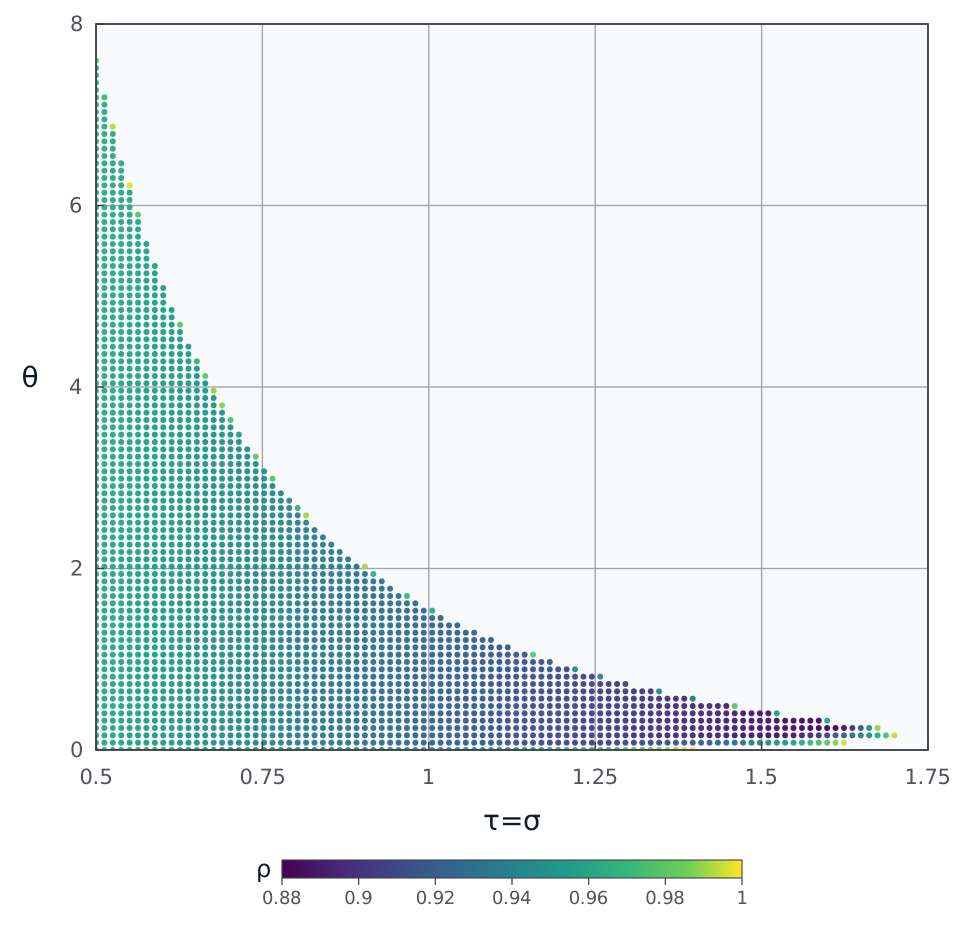
Sweeping over 100 values of \(\tau=\sigma\) on \([0.5,1.75]\) and 100 values of \(\theta\) on \([0,8]\) with \(f_1,f_2\in\mathcal{F}_{0.05,50}\) gives the plot below. Each dot is a feasible parameter pair, and the color encodes the certified contraction factor \(\rho\).
References
Antonin Chambolle and Thomas Pock. A first-order primal-dual algorithm for convex problems with applications to imaging. Journal of Mathematical Imaging and Vision, 40(1):120–145, 2011. doi:10.1007/s10851-010-0251-1.